What 'infrastructure as code' actually buys you
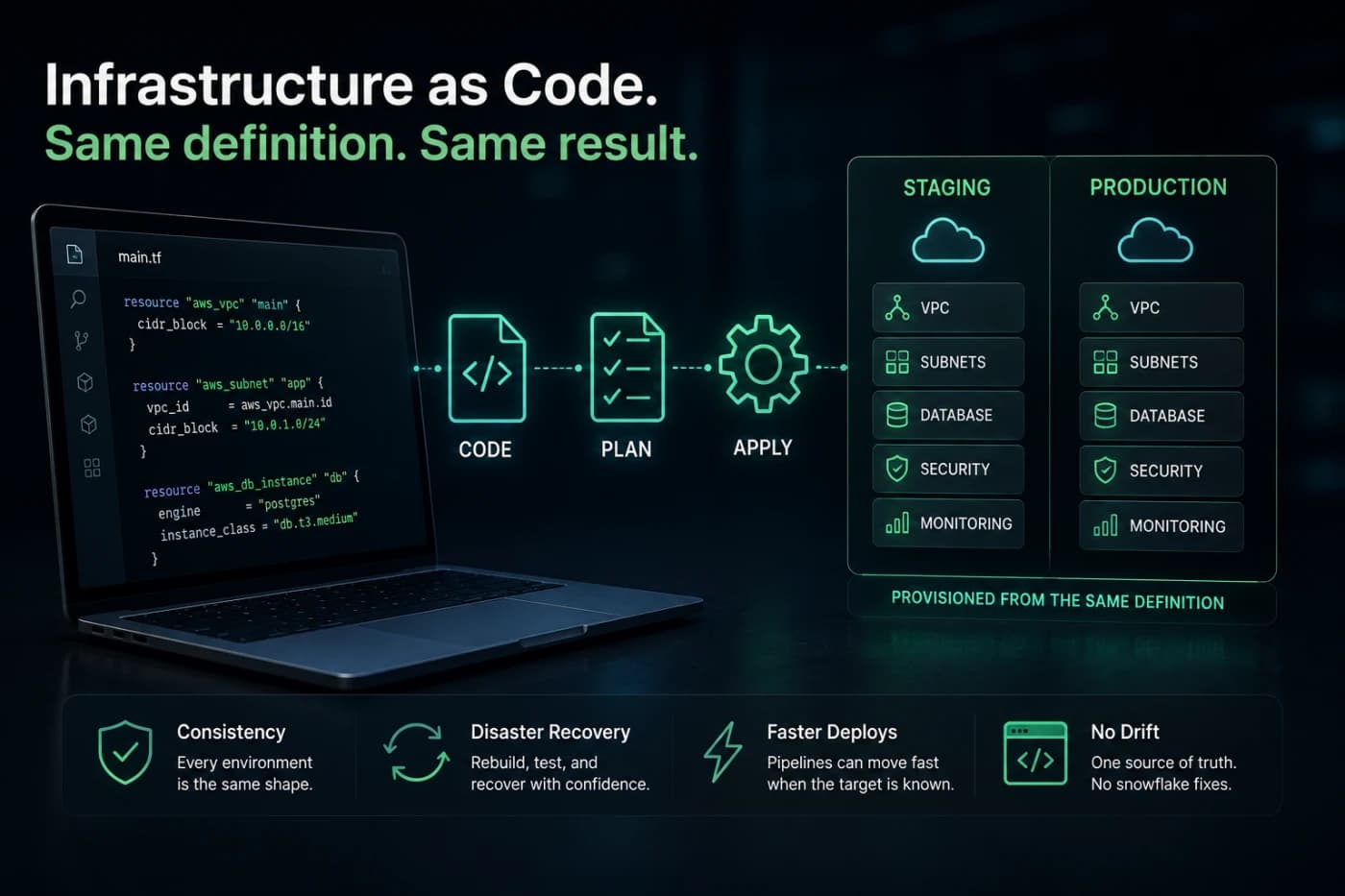
Said out loud, "infrastructure as code" sounds like a style choice — Terraform instead of clicking through a console. What it actually buys you is a guarantee: every environment was created from the same definition, so staging and production are provably the same shape instead of "probably" the same shape.
That guarantee is what makes disaster recovery real instead of theoretical. If your infrastructure is defined in code, you can spin up a full replacement environment from scratch and test that it works — on a Tuesday, on purpose — instead of finding out during an actual outage whether your backups were ever restorable.
It also changes what a deploy pipeline can trust. A pipeline that deploys onto infrastructure nobody's certain matches production has to be conservative, slow, and hedged with manual approval steps. A pipeline that deploys onto infrastructure it provisioned itself can move fast, because the target is a known quantity.
The part that takes discipline: resisting the console "just this once" fix. One manual change to a production resource that isn't reflected in code is the beginning of drift, and drift is what turns "infrastructure as code" back into a style choice nobody actually benefits from.
Have a question about this article — or your own project?
Ask us anything about the approach above, or tell us what you're building. You'll hear back from an engineer, not a sales script.